RevSec AI: Bridging the Gap Between Strategy and Execution
This post covers how I led the product discovery, technical architecture, roadmapping, and execution of RevSec AI—a unified and agentic pricing intelligence, product strategy, and RevOps platform for product teams, founders, and GTM. Featuring a 21-day stakeholder discovery sprint, strategic pivots in AI infrastructure, and a ~70% reduction in system latency.
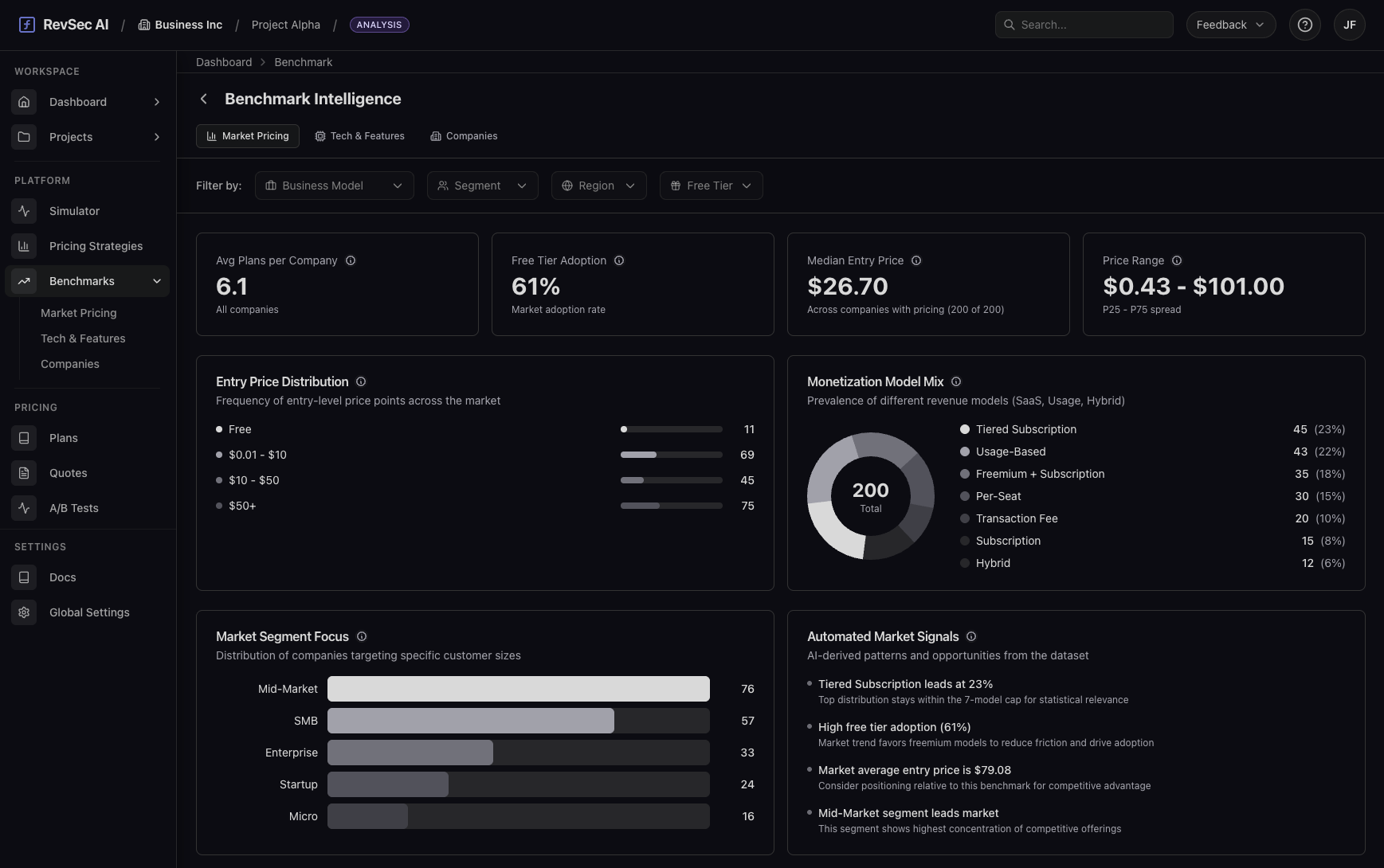
Table of Contents
- The Problem Space
- Discovery & Strategy Sprint
- The Solution: A Unified Strategy Workspace
- Technical Product Management & Pivots
- Systems Architecture
- What This Demonstrates
Role: Technical Product Lead & Builder
Timeline: 6 Months (Zero to Production)
Stack: Nuxt 3, Rails 8 API, AWS Bedrock, PostgreSQL
Key Achievement: Reduced AI latency by 50% via architectural pivot.
Research Signal: 10+ Stakeholder Interviews (Founders/RevOps).
The Problem Space
AI and SaaS companies often make pricing decisions based on "gut instinct" and fragmented spreadsheets. Revenue operations teams juggle disconnected billing platforms and BI dashboards with no shared context. Pricing strategy becomes a bottleneck rather than a growth lever because research is never tied to execution.
Discovery & Strategy Sprint
To move beyond assumptions, I embarked on a 21-day intensive discovery sprint during a 4-week holiday in New York with my family. I conducted in-depth interviews with 10 stakeholders, including Founders and RevOps leads, to gain valuable insights. This research transformed the product from a “tool for analysts” into a “unified workspace for operators.”
Insight 1: The "Sterile Tool" Gap. Founders described their billing stacks as "obligations, not assets." This validated a UX-first differentiator—building a platform that prioritizes workflow design over basic utility.
Insight 2: Context Fragmentation. 80% of participants reported that strategic intent is lost when moving from research (spreadsheets) to execution (Jira/Stripe). This led to the decision to build Project Management as a core primitive, not a bolt-on.
Insight 3: The Need for Evidence. Competitive analysis showed a lack of structured A/B testing support. I prioritized an Experimentation Engine to allow teams to run hypothesis-driven pricing tests.
The Solution: A Unified Strategy Workspace
RevSec AI replaces the patchwork of tools with five integrated "agentic" surfaces:
RevOps Analytics: Live revenue trend modeling and experiment tracking.
Project Management: The connective layer (Kanban/Gantt) that ties research to tasks.
Competitive Benchmarking: RAG-enhanced benchmark dashboard with market positioning, features, and tech-stack analysis, powering multiple features within the platform and across each of the core services.
Plan Management (CPQ): Full lifecycle management with Stripe bidirectional sync.
Strategy Engine: AI-powered recommendations with "Logic Trace" transparency (no black boxes).
Technical Product Management & Pivots
As both the PM and Lead developer, I managed several critical technical trade-offs to ensure the platform met professional-grade standards:
Performance Optimization: Initial testing of AWS Bedrock showed a ~20s latency for strategy generation (pricing strategy with full logic trace and CPQ, financial modeling charts, success criteria, competitive analysis). By migrating to a synchronous parallel pipeline and optimizing token consumption, I reduced latency by over 50%, ensuring a responsive UX for enterprise users.
Strategic Feature Pivot: I initially envisioned a pure analytics engine. However, user testing proved that insights were "unauditable" without an execution layer. I re-scoped the sprint to include a CPQ layer and Stripe integration, doubling the platform's utility and "stickiness."
Math First, AI Second: To ensure data integrity, I architected the system so that LLMs perform synthesis and communication, while core financial calculations are handled by deterministic Ruby service objects.
Systems Architecture
Frontend: Nuxt 3 with decoupled Vue composables (useSimulator, useProjectMetrics) for logic reuse across dashboards.
Backend: Rails 8 API with a RESTful contract across 12+ interconnected resources; real-time collaboration via ActionCable.
AI Engine: AWS Bedrock (Claude) orchestrated via parallel prompt chains for RAG-enhanced market analysis.
Data Integrity: Ingests live cloud pricing and FRED macroeconomic data to power deterministic financial impact dashboards.
What This Demonstrates
Product Discovery: Validated a UX-first thesis through 10+ interviews and let data drive the roadmap.
Technical Execution: Shipped a complex, multi-service production environment solo in six months.
Strategic Scoping: Made deliberate decisions to pivot (Usage-rate metering) and defer (Billing-as-a-service) based on market signals.
Systemic Thinking: Designed a unified data model where projects, simulations, and quotes share context through normalized relationships.
For a more detailed breakdown of this project, covering system architecture, product strategy, execution breakdown, roadmap development, and more.
You can also review the business landing page to learn more about the platform and review each core service and feature. RevSec AI Business Landing Page