RevSec AI - Pricing Intelligence and RevOps Platform
Full-stack SaaS platform built solo from 0→1 — a unified workspace for product teams, founders, and RevOps to research, model, and ship pricing strategies end-to-end. Nuxt 3, Rails 8, AWS Bedrock, PostgreSQL. Spans AI-powered pricing simulation, competitive benchmarking, product discovery, project management, plan management with CPQ and quoting, and experiment tracking. Claude prompt chains with RAG pipelines produce risk-scored recommendations with full calculation transparency.
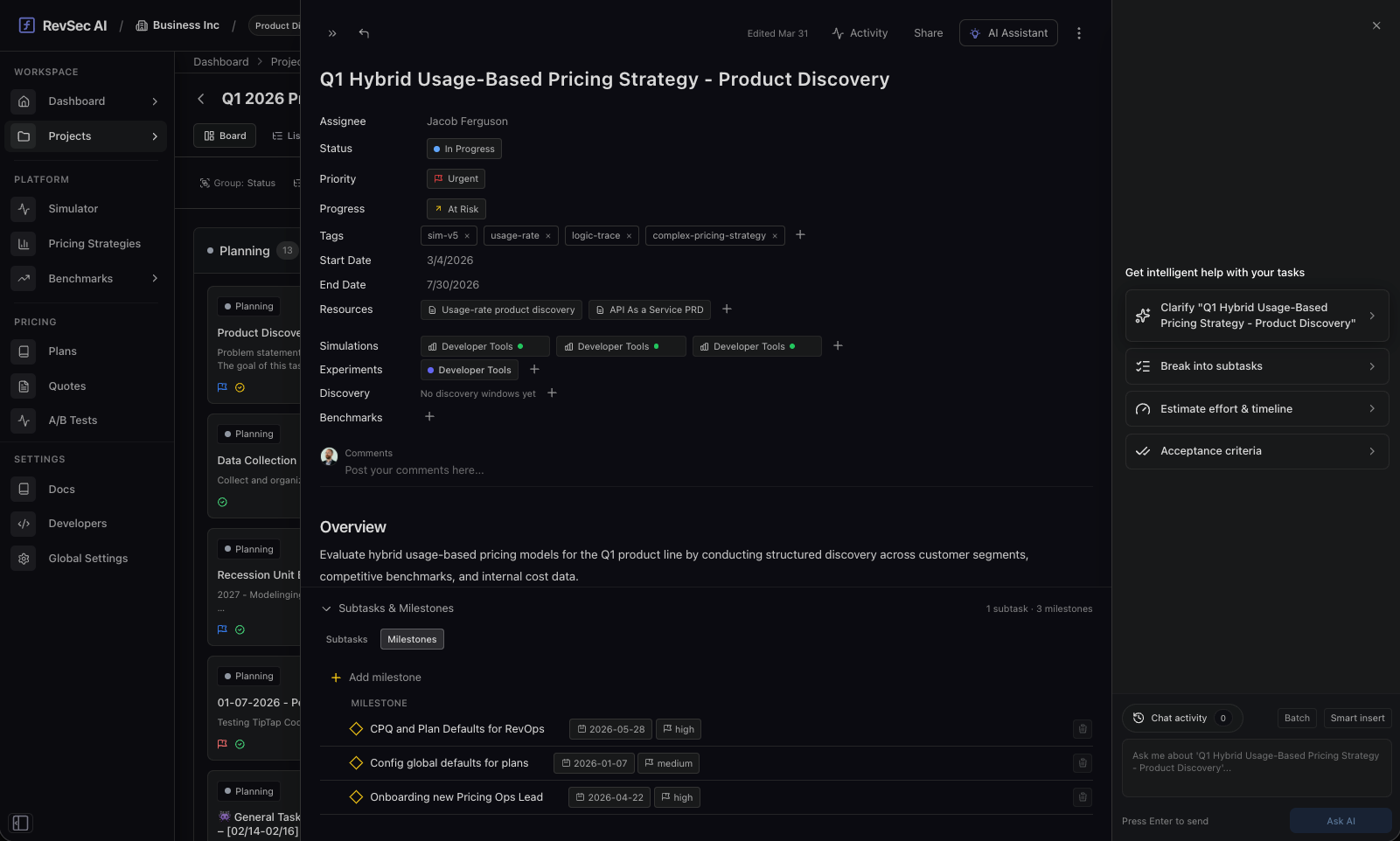
RevSec AI — Pricing Intelligence & RevOps Platform
The Problem Space
AI, API, and SaaS companies make pricing decisions using spreadsheets, gut instinct, and fragmented tools. Competitive intelligence lives in analyst decks nobody reads. Pricing experiments run without structured hypotheses — and most platforms don't support A/B testing and proper experimentation for pricing strategy and product discovery. Revenue operations teams juggle disconnected billing platforms, BI dashboards, and project management toolsets with no shared context between research and strategy, so pricing strategy, discovery, and research become a bottleneck instead of a growth lever.
Discovery & Validation
Early market research revealed a crowded but shallow competitive landscape. Platforms like Pricefx, Zilliant, and Stigg each address a slice of the pricing workflow — analytics, CPQ, or billing — but none provide a unified workspace that connects research to execution end-to-end. Plan management and CPQ tools across the market are particularly sterile: they treat pricing as a utility function rather than a strategic decision surface, offering little contextual "agentic" intelligence to inform the user while they work.
A pivotal founder interview surfaced two insights that shaped the product direction:
UX is an underserved differentiator. The founder described a complete lack of enjoyment using their billing stack — functional but uninspiring tools that feel like obligations rather than assets. This pointed to an opportunity to build a UX-first pricing platform where interface quality and workflow design are competitive advantages, not afterthoughts.
Tool fragmentation is the real pain. The disconnect between their pricing research, billing platform, and project management tools meant strategic context was constantly lost in translation. This directly informed the decision to build project management as a core feature — not a bolt-on — tying every service together through a unified workspace.
Continuous competitive analysis also identified a critical gap: most platforms lack native support for pricing A/B tests and structured experimentation. This became a foundational capability in RevSec AI's experiment workflow.
Through ongoing market research, I identified an additional need to introduce usage-rate metering and analytics to support the growing number of businesses adopting usage-based pricing models. This expanded the platform's scope from a pure intelligence engine to a system that ingests live billing data — powering more accurate strategies and positioning the platform to offer billing as a core service as customer demand warrants it in the future.
The Solution
RevSec AI gives product, RevOps, and GTM teams a single workspace to research, model, validate, and ship strategies end-to-end. It replaces the patchwork of spreadsheets, BI dashboards, and disconnected tools with a unified system of record for pricing decisions and product strategy.
The platform spans five integrated agentic surfaces:
- RevOps Analytics Dashboard — strategic metrics, revenue trend modeling, and experiment performance tracking with live and projected data modes
- Project Management — Kanban boards, Gantt timelines, calendar views, and task hierarchies with milestones, discovery windows, and experiment windows — the connective layer that ties every other surface together
- Competitive Benchmarking — company-level pricing analysis with feature matrices, tech-stack, price percentile distributions, and market positioning charts
- Plan Management with CPQ — full plan lifecycle from draft to published, with entitlements, usage-based tiers, volume discounts, quote generation, and Stripe sync — designed to surface actionable intelligence inline rather than treating plan configuration as a sterile form
- Interactive Pricing Strategy engine — AI-powered pipeline and engine producing pricing strategy tables, financial impact dashboards, sensitivity analysis, and recommended moves with full logic trace transparency
A core design principle: the platform enforces a structured workflow from discovery → simulation → experiment → execution. Every pricing decision is traceable back to the research and modeling that informed it, so the platform is devoid of blackbox computational processes or AI services. If we recommend a strategy, we outline each step episodically that led to that decision.
Key Product Decisions
Unified workspace over a point solution. The founder interviews and competitive analysis both pointed to the same conclusion: the market doesn't need another standalone tool. RevSec AI's project management layer is designed to eliminate context loss that occurs when teams switch between research, modeling, and execution tools. A pricing experiment created from a simulation snapshot carries its full context — AI strategy table, financial projections, recommended moves — into the project timeline with status tracking and progress metrics.
UX-first design philosophy. The interface follows a systematic monochromatic greyscale design language with brand accent colors reserved for semantic meaning, with support for light theme — positive/negative deltas, status indicators, and interactive affordances. This wasn't an aesthetic choice; it was a direct response to the validated insight that existing tools feel like obligations. Every surface is designed to be a workspace users want to spend time in, with contextual data surfaced inline rather than buried in separate reports.
Usage-rate metering pivot. The original scope was a pure intelligence engine sitting between the user's product development and payment processor. Market research revealed that usage-based pricing models are increasingly common but poorly supported by existing tools. Adding metering and analytics expanded the platform's data foundation — live usage data powers more accurate strategies — while opening a future opportunity to offer billing as a core service.
Architecture & Technical Implementation
Frontend: Nuxt 3 (Vue 3 Composition API), Tailwind CSS, Pinia state management, ApexCharts and Chart.js for data visualization, Tiptap for rich-text editing, Business logic lives in decoupled Vue composables (useProjectMetrics, useSimulator, useProjectScheduleApi), enabling the same metric aggregation logic to power both project-scoped analytics and future global dashboards without duplication.
Backend: Rails 8 API with service-layer architecture, PostgreSQL, and session-based auth with RBAC (owner, admin, editor, commenter, viewer). RESTful contract across projects, kanban cards, pricing experiments, plan library, CPQ quotes, simulation snapshots, and settings registries. Real-time collaboration via ActionCable with autosave and lock versioning to prevent conflicts.
AI Engine: AWS Bedrock with Claude-powered prompt chains orchestrated through Rails service layers using synchronous parallel processing for sub-second response times. Key pipelines include:
- Competitive benchmarking — RAG-enhanced analysis ingesting unstructured market data into structured company profiles with pricing model classification, feature-value matrices, and market positioning scores
- Pricing strategy engine — multi-stage prompt chains synthesizing business inputs into risk-scored pricing recommendations with full calculation transparency via logic traces
- Discovery automation — structured templates for Van Westendorp analysis, conjoint-style preference modeling, and hypothesis generation feeding directly into experiment configurations
External data source - The platform ingests cloud pricing data and FRED macroeconomic data, which powers each dashboard experience and the strategy generation engine.
Design principle: LLMs present findings, never decide. Every AI output includes confidence scores, data quality assessments, sensitivity ranges, and the complete calculation path so users can audit the reasoning.
Stripe integration as a first-class citizen. Plans sync bidirectionally with Stripe products and prices. The CPQ layer generates quotes with line items mapped to Stripe-ready configurations — the path from "AI recommends this price point" to "customer sees this on their invoice" is a single workflow.
Infrastructure: Fully deployed on AWS for GA — EC2 for the Rails API, S3 for assets, RDS PostgreSQL, and Bedrock for AI inference. The entire platform was shipped solo from zero to production in six months.
Go-to-Market
The GTM strategy is designed for capital efficiency as a solo founder. An automated inbound pipeline handles customer support and sales qualification — incoming requests will be triaged by an AI agent that validates prospects (org size, current pricing model, intent signals) and drafts responses for human-in-the-loop review before sending. This allows the sales process to scale without headcount while maintaining quality and learning from every interaction during the pre-PMF phase.
What's Next
- Hire co-founder, data operations, and full-stack engineering roles between now and GA
- Expand usage-rate metering into full billing-as-a-service based on customer demand signals
- Enrich competitive intelligence pipelines with broader market data sources
- Parse and incorporate additional discovery research toolsets to deepen the validation foundation and potentially capture a segment of another market
What This Demonstrates
- Product discovery in practice — validated a UX-first thesis through founder interviews, competitive analysis, and continuous market research, then let those insights drive architecture and feature decisions rather than building on assumptions
- Full-stack execution — Nuxt/Vue frontend with complex state management, Rails API with service-layer patterns, PostgreSQL data modeling across a dozen interconnected resources, real-time WebSocket infrastructure, and production AI pipelines — shipped solo in six months
- Strategic product thinking — made deliberate scope decisions (adding metering, building PM as a core feature, deferring billing-as-a-service) based on market signals rather than feature creep, with a clear expansion path tied to customer demand
- Systems design — a unified data architecture where projects, tasks, simulations, experiments, plans, and quotes share context through normalized relationships rather than siloed feature modules
- Design systems — a cohesive dark-theme UI built on a systematic greyscale palette with semantic color usage, consistent component patterns across 30+ views, and accessibility-compliant interactive elements